|
Tue 12 Aug 2014
Margaret Dickinson. Yorkshire’s Ancient Secrets and Curiosities. |
|
Nelson born
Maggie had been a fell walker for over 20 years and a member of
the famous Clarion Cycle Club. Through these activities she
gained a love and intimate knowledge of Yorkshire which was
borne out through her talk and backed up with an excellent
collection of her own photographs presented on screen.
Her talk started with the area historically called East Riding
which covered places that were a little bit off the beaten
track, hence the title of her talk.
These ranged from the strange stone monoliths in the village of
Rudston. The reason for their existence was not explained but
then the reason might just have been lost over the centuries.
Images were shown of idyllic village scenes but not just for
their beauty alone. They each had some historical, often little
known, connection. Rudston, for instance, was the birthplace of
Winifred Holtby, author of the book, South Riding. |
|
One village,
Kirby Grindalythe, was shown probably in part because of its
name.
Another image showed the view of a watery meadow from the steps
of a country church. Very pretty but Maggie added it was the
view from All Saints Church, Brompton by Sawdon. And on 4
October 1802 would have been seen by the poet William Wordsworth
as he left the church with his new bride, Mary Hutchinson.
A particular gem was a view of a turf cut maze, one of only 8 in
England. This particular one was close to the villages of
Brandsby, Dalby and Sheriff Hutton. This is one of 3 in the
country nicknamed the ‘City of Troy’, the city in present day
Turkey mentioned in ancient Greek literature, due to the
difficulty of finding a way out after entering it. |
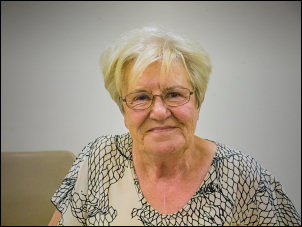
Maggie B. Dickinson |
|
Additionally,
the remains of Sheriff Hutton’s castle were featured due to its
Richard III association. It was owned by the Neville family and
housed the king’s niece and nephew.
Onto the Yorkshire Dales with a particular focus on Dent and
Dent Dale, now in present day Cumbria but don’t tell that to the
locals. Maggie spoke of her family connection with the area and
its special identity, such as the ‘Terrible Knitters’. Those
men, women and children were, in modern day parlance, ‘extreme’
knitters.
Dent is the birthplace of Adam Sedgwick on 22 March 1785, one of
the founders of modern geology and a blue plaque marks the
place. Maggie also mentioned Dent’s connection with the
quarrying of marble.
Ribblehead viaduct was built by a workforce of 6,000 navvies
between 1869 and 1876. They lived in shanty towns but many died
during its construction. A plaque commemorates the men who died
there, not the women, in a nearby churchyard.
An example of the peculiar Austwick ‘erratics, where large
pieces of very old rock lie, somewhat precariously, atop
limestone was shown.
Amongst many interesting images of the dales a particular
anecdote of Maggies stood out. She spoke of a location on the
road between Kettlewell and Starbotton. The exact location,
Maggie would give the OS grid reference if anyone emailed her,
was close by a road side bench. If one turned towards the
hillside and shouted an echo would be heard.
She told us that she would never have known of this curiosity,
and many more, if it was not for the advice given to her many
years ago by members of the Clarion Cycle Club. This was to seek
the quiet lanes and places and you will find places of special
interest.
Advice she took on board and advice she gave us too. And what an
interesting collection of stories and photographs she presented
to us.
Peter Robinson
August 2014 |
|
 back
back