|
|
|
Tue 13 May 2014
Gordon Meddlicott - The Last Lighthouse Keeper. |
|
Gordon asserted
from the outset that he was the last lighthouse keeper and then
began to tell the story about his career.
He explained it was never his first choice of career as he,
having been brought up within sight of the Mersey, joined the
Merchant Navy in the 1950’s as a navigator. Unfortunately, after
6 years in the merchant marine he didn’t pass his final test and
no shipping line would take him on.
Consequently, he undertook the 5 year training programme to
become a lighthouse keeper. He served on all 3 categories of
lighthouse; those on the mainland, those on islands and those on
rocky outcrops out at sea.
Trinity House, a 500 year old private corporation, owns and
operates the lighthouses around England and Wales and, as a
legacy of Empire, Gibraltar, Falkland Islands and Anguila in the
West Indies. Scotland and Ireland have their own authority.
All its income comes from a levy on ship owners and always has
been.
Gordon vividly described life on a lighthouse out at sea that
was manned by 3 men, 2 months on duty with 1 month ashore. A
Spartan lifestyle best described the living conditions and each
man was reliant on the others. There were just 6 rooms in a
lighthouse, bedroom, kitchen, storage room, fuel storage, duty
room and the lamp room. There was no bathroom just a bucket. A
‘bucket and chuck it’ regime was in place but care had to be
taken when ‘chucking it’ out in strong winds. |
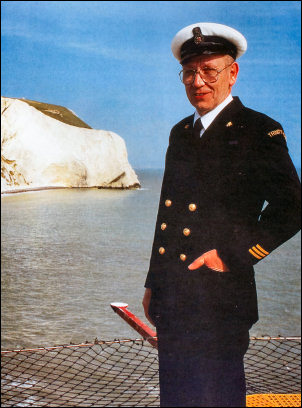
Gordon Meddlicott before retiring. |
|
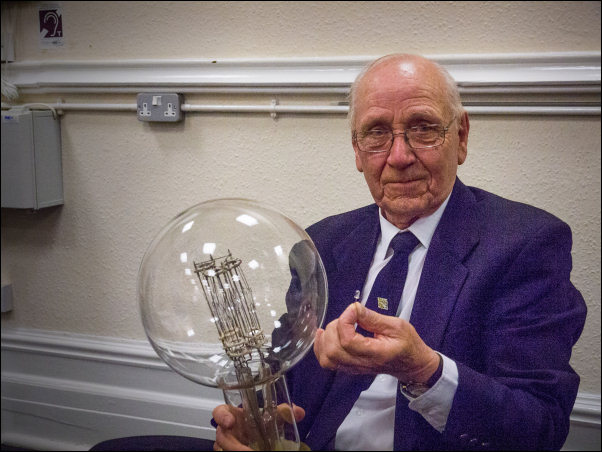
Gordon compares an old style bulb of 3,500 Watts and a modern
LED replacement
|
|
Changes of duty
and, of course, supplies of food and fuel went ahead only when
weather permitted. This could delay a departure at the end of
duty, which would directly shorten time spent ashore.
Paraffin oil fired the lamps until the 1980’s and in addition to
this, stocks of coal, rockets and explosive charges were kept in
a lighthouse. A dangerous place indeed!
Life spent in a confined space had to be well organised and
whatever your rank; head keeper, deputy keeper or junior keeper,
you took your turns with chores like cooking.
Developments in the 1980’s, particularly with electronics, led
to a programme of automation of lighthouses. Initially on the
mainland, then those on islands and finally out at sea. It was
only the addition of a helipad atop lighthouses did repairs, etc
cease being supplied by ship and, therefore, less weather
dependent.
Gordon showed interesting examples of bulbs past and present
that illustrated the significant technological developments that
have been made. |
|
North Foreland
lighthouse in Kent was the last to be automated on 26 November
1998. Gordon was the third man that left the lighthouse after
finishing their final shift that day. So, making him the, ‘last
lighthouse keeper’.
Gordon’s fascinating talk cast a bright light the now extinct
role of a lighthouse keeper and the conditions they experienced
to ensure the safety of shipping around the British Isles.
Peter Robinson
May 2014 |
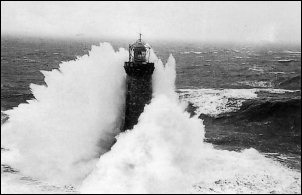
Lighthouses have to withstand some
incredibly bad weather. |
| |
|
|
 back
back