|
Tue 08 Apr 2014
David Hill - The Crystal Palace and The Great Exhibition. |
|
David’s opening
statement was of his admiration of the Victorians’ certainty in
their world and of their great achievements.
The Crystal Palace was just one of them and he set out to
explain why it came about and how it became, in his words, the
world’s first ‘leisure centre’.
Queen Victoria’s husband, Prince Albert, was president of the
Royal Society of Arts (RSA) that included men like John Scott
Russell and Henry Cole. In the mid 1840s Russell and Cole had
visited Paris to see an exhibition that displayed goods and
crafts from around the French empire.
They had the idea to put on a much bigger exhibition that
promoted the best of Britain and its empire. It was planned for
1851 to show ‘art, culture and civilization’ without the support
of any public money. A royal commission was set up to plan the
event that included the prime minister, Robert Peel, Russell and
Cole.. |
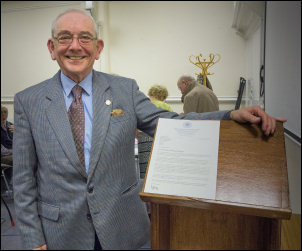
David Hill |
|
Designs for the exhibition hall were invited and amongst them
was one from a Joseph Paxton. Without formal education he had
risen to the post of head gardener at Chatsworth House. He had
designed bridges and buildings and had become a brilliant
engineer.
His successful design was created in 2 weeks and was of a
building that was 1,851 ft long (it was actually 1,848 ft long).
It consisted of over 3,000 standard sections in cast and wrought
iron and included 290,000 panes of glass.
It was constructed in Hyde Park and builders were on site on 31
July 1850 and it was completed in 9 months, an engineering
achievement as well as architectural.
|
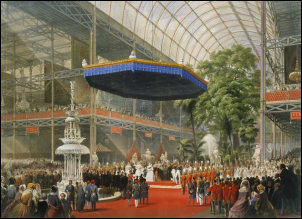
The Crystal Palace
and the opening of the Great Exhibition
by Queen Victoria 1851
(Source Wikipedia) |
|
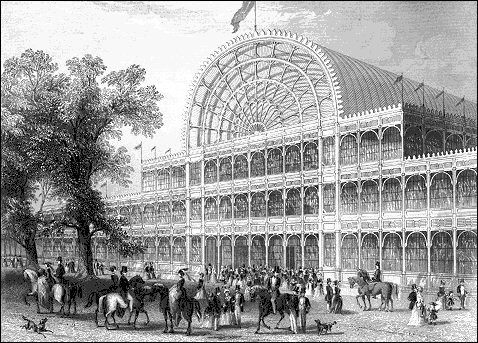
The original Crystal Palace
(Source Wikipedia) |
|
The exhibition
was opened on 1 May 1851 by Queen Victoria was scheduled to stay
open until mid- October. All London’s police and troops were put
on standby for the duration of the exhibition, which caused
traffic chaos.
The organisers wanted the exhibition’s aims to include
education, learning and improvement, not just fun. Consequently,
they wanted as many people as possible to visit it so there was
a range of ticket prices.
It closed on 11 October 1851 after 6 million people had visited
it and was £180k in profit.
However, it had to come down and it was dismantled and
re-assembled on a 200 acre plot on Siddenham Hill, south London.
It opened on 10 June 1854 and Queen Victoria agreed to open it
again. It became venue for all sorts of events that included
boxing, brass bands, scouts and shows. Unfortunately, over the
years it began to lose money and the company running it went
bankrupt in 1909. After that London County Council ran it
through a trust company.
It was on 30 November 1936 that the Crystal Palace was destroyed
by fire and its remains were sold for scrap.
David concluded his highly interesting and enjoyable talk by
restating that the Victorians’ achieved fantastic things that
included the Great Exhibition and the Crystal Palace. All
present could not but agree with his statement.
Peter Robinson
April 2014
|
|
 back
back