|
Tue 10 Feb 2015
Dr Mark Turner – A Brief
History of
Rolls Royce |
|
A much larger than average attendance welcomed Mark who said he
was in his 39th year of employment at Rolls Royce. He is, in
fact, an engineer, one of 15,000 at the company. Not only that,
he is a senior engineer and just one of ten senior fellows
there. In short he ‘fixes difficult problems and helps to drive
technology forward’.
It all started for Rolls Royce when Charles Stuart Rolls, the
man the money and a passion for cars joined up with Frederick
Henry Royce. He was the engineer with his own company that
produced cranes and dynamos.
The Midland Hotel, Manchester in 1904 was where the 2 men first
met. It was 2 years later that the company was established and
its first car, the Silver Ghost, was launched. |
|
Tragically,
Rolls died in 1910 in an aviation accident. He was the first
Englishman to die in such a manner.
Royce, became seriously ill and move to Sussex. He, however,
approved new designs all the way up to his death, aged 70, in
1933.
A lasting legacy of the company was that ‘whatever is done,
however humble, is noble’.
Mark said his talk would concentrate on the aerospace side of
the business and added the first aero engine was produced in
1914 and was named the kestrel. This was the first of a series
of aero engines named after birds. It culminated in the famous
merlin engine that powered the Spitfire. |
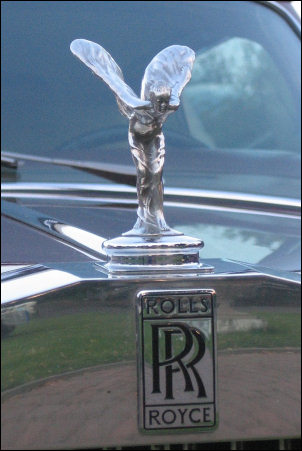
Spirit of Ecstasy - The Flying Lady |
|
It was at the
outset of World War II the company’s association started with
Barnoldswick. Engines produced there powered Spitfires,
Hurricanes, the Avro Lancaster and the Halifax.
In 1943 the company took on the ongoing development of the jet
engine. This resulted in a series of jet engines during the
1950s and 1960s that drove technology forward. The RB 211, that
powered the Lockheed Tristar, was a technical success. But the
underestimation of development costs led to the company going
into receivership and nationalisation in 1971.
The car and aerospace parts of the business were separated in
1973. Success, though, continued with a the Trent family of jet
engines, which help to power aircraft such as Boeing 747s, 787s
and Airbus A350s.
|

The Parke family of Withnell Fold
in their Rolls Royce. |
|
The company’s
presence continues at Barnoldswick but now it is involved in
cutting edge hollow fan blades and electron beam welding.
Mark’s talk although technical in many respects was also
compelling as the story included people and their characters,
not just machines.
His presentation also had humour, not least his images of air
travelling through a jet engine that graphically illustrated its
4 sequences, ‘suck’, ‘squeeze’, ‘bang’ and ‘blow’.
His technical knowledge was conveyed in such a way that he held
everyone spellbound with his brief history of Rolls Royce.
Peter Robinson |
|
 back
back