|
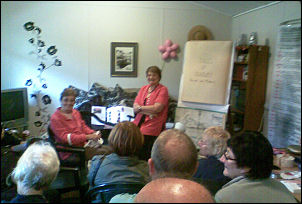
Irene Owen was our speaker this evening and her talk was about
'THE TALES OF DUXBURY' The cottage where she and George live, on
the Duxbury estate, is called Londonderry Cottage and is 425
years old.
The first settler was DEOWUC in 600 A.D. and built a fortified
farm (Bur), possibly the first Duxbury. |
taken June 2011 |
|
The Duxbury family tree goes back as far as 1202. 1315 was a
very important date, the Banastre rebellion. Lands of Standish
and Shevington. Battles fought by close neighbours. Sir Henry de
Burry was murdered. Standishes's took over Duxbury Hall. The
Duxbury's were very influential, but the Standishes became more
important. In the old barn of the old hall timbers dated to 15c.
There was a Pele tower which protected the area and was also
used for shelter. There have been huge stones found on the
Duxbury estate which possibly were from the Pele tower. In the
old barn, the chieftains barn, there was a bedchamber for the
Lord and Lady and another one for the women. All the men slept
in the hall. Hall 'ith Hill also a possible residence of the
Duxburys. Bretters Farm was moated, and C.H.A.S. found remains
of artefacts from Saxon times to 16c in the recent past. 1571
there is a court roll reference to the Manor House of Duxbury
(Duxbury Hall). Also discovered, 6 pairs of oak crux (barn) on a
stone base, fastened by three cross pieces. The Standish line
family tree can be traced from 1221 to 1846.
1434 Sir Roland Standish fought under Henry V at Agincourt and
brought home the remains of St. Laurence and returned them to
the Parish Church, Chorley (reputedly.) Lands connected to the
Standishes also covered areas around Heapey, Duxbury,
Worthington, Langtree, Heath Charnock, Chorley etc. The Lord
became the tenant for life and had to look after the estate and
its people. 1533 was the time of Henry V111 and the Reformation.
The Standishes of Duxbury were Protestants and the Standishes of
Standish were Catholics. Miles Standish was educated at
Rivington Grammar School (the small old school, now a Junior
school). 1622 Sir Thomas Standish rebuilt Duxbury Hall and and
chapel (St. Wilfreds). 1670 the Hearth Tax was introduced, and
1727 the Cornmill was refurbished. Myles Standish, who was
nicknamed Captain Shrimp sailed the Mayflower to Plymouth,
Massachusetts. Hobernock who was a firm friend and stayed with
him for the rest of his life. Three Standing Dishes are the
Standish Coat of Arms. The two churches of St. Laurence and St.
Wilfreds were very important to the Standish family. 1859 two
thirds of Duxbury Hall burned down, then was rebuilt with the
insurance monies. 1891 was the sale of Duxbury Park Estate. From
1898 to 1932 George Owens (Irene's husband) grandad was the
Gamekeeper at Duxbury. Over the years the Cornwells
were also part of Georges family. The Yarrow Bridge hotel used
to be called the Standish Arms. There were 4 Coal Mines at
Duxbury, namely: Duxbury, Carr, Yarrow and Duxbury Park.
Documents date back to 1354 for the Old Mill, and there was also
quarrying and textiles carried on at Duxbury.
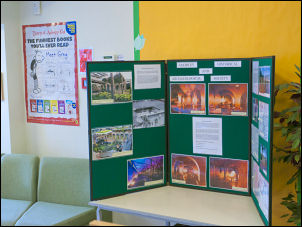
This evening has been a very interesting story of Duxbury
supplemented by Family trees, photos, maps and artefacts. It has
been a delightful evening. I hope you find the snippets, I
managed to record, of some interest.
J.D. |
 back
back