|
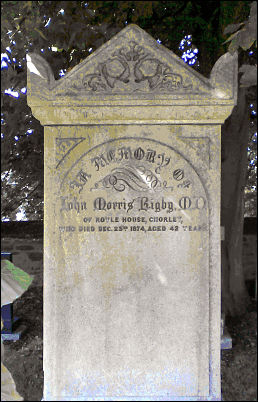
Even in the
1870s, his death at 42 seemed very young and my curiosity lead
me to check out his newspaper obituary. (Chorley Reference
Library has a very helpful index of Chorley Guardian obituaries
coming up to relatively recent times.) I read the Guardian’s
obituary and then also checked the obituary in the Chorley
Standard, the “other” Chorley newspaper at that time. I’m glad I
did! I noticed immediately that the Standard’s obituary was much
longer, 541 words, as compared to 320 in the Guardian. Now that
might have been down to the verbosity of the Standard’s obituary
writer, but closer scrutiny revealed significant differences, as
well as similarities, in the information provided.
Similarities
•Age 42
•Died at his residence in St. Thomas’s Road.
•Eldest son of John Rigby Esq.
•Qualifications (MD, MRCSE, LM and LSA)
•Genial personality.
•Freemason.
Differences
•Versions of a life debilitating illness. The Chorley Guardian
reported “About nine years ago Dr. Rigby, when conducting a
post-mortem examination, had the misfortune to become
accidentally inoculated with virus, the effects of which were so
severe at the time that it was feared he would succumb under
them.” The Chorley Standard reported “ Whilst engaged some eight
years ago in performing a post mortem examination of the body of
a man who had been found dead, he accidentally allowed a sore
finger to come into contact with the matter, the consequence was
that symptoms of blood poisoning set in; and although everything
possible was done to counteract the evil effects, the doctor
never recovered his previous robust health.” It’s fascinating
that the Guardian used the word “inoculated”, which at that time
was quite emotive, with strong feelings for and against
inoculation. Whether the writer was showing his ignorance or his
prejudice we can only summise.
•Fatal illness. The Chorley Guardian reported “At the last
Manchester Assizes he had to attend the court for three days,
which aggravated a slight cold from which he was suffering, and
subsequently St. Anthony’s fire or erysipelas set in with great
severity.” The Chorley Standard provides more detail “ Whilst
attending the recent funeral of the late Mr. Cheetham, the
doctor caught a severe cold and before he had well got quit of
it, he had to attend the Manchester Assizes in the Wrightington
shooting case, through which his cold became intensified and
erysipelas in the head (can’t read) about a fortnight since.”
•Scientific research. Not mentioned at all in the Chorley
Guardian but the Chorley Standard reported “ Dr. John Rigby
possessed in a remarkable degree talents for scientific
research, especially in chemistry and botany, for which latter
science we may say he was an enthusiast, for he has travelled
with Mr. (can’t read) a local botanist, long distances (can’t
read) and we know nothing gave the doctor so much pleasure as
when he recounted to an attentive listener the beauties of the
many rare botanical specimens which his garden and conservatory
contained.” (It’s a pity that it is not possible to read the
name of the local botanist!)
•Official positions. Some commonality but some differences in
the listing of official posts that he held both as a doctor and
as a Freemason. For example only the Guardian mentions that John
Rigby was Assistant Surgeon to the 3rd Brigade of the Lancashire
Voluntary Artillery, and only the Standard records “he was
elected, from a number of applicants, to the newly-created
office of Medical Officer to the Rural Sanitary Board for the
Chorley Union (exclusive of the townships ruled by local
boards), which office he occupied at the time of his decease.”
I think what this has shown is that newspapers are certainly a
major source for local historians of the 19th and 20th
centuries, but, even so, they only give one picture of an event
or person. To make that a three-dimensional picture, other
sources, including other newspapers did to be searched and
analysed.
John Harrison
March 2008 |
 back
back